Nov 05, 2026
For businesses in Kenya, electricity is more than an operating expense. It affects production schedules, refrigeration, lighting, communications, equipment performance and the ability to serve customers. A well-designed commercial solar power system can help businesses reduce dependence on grid electricity, manage energy costs and maintain more reliable operations when power supply is unstable or unavailable.
However, the right solar solution depends on how a business uses electricity. A factory with heavy machinery has different requirements from a hotel, a farm or a rural retail facility. This guide explains how businesses can choose commercial solar power systems in Kenya, compare on-grid, hybrid and off-grid configurations, and evaluate solar suppliers for long-term project performance.
Why Are More Kenyan Businesses Considering Commercial Solar Power?
Kenya has strong solar potential, making photovoltaic systems a practical option for many commercial and industrial applications. Businesses can generate electricity during daylight hours and use it directly for operations. When battery storage is included, excess solar energy can also be stored for use later, depending on the system design.
For commercial users, the main reasons to consider solar power include:
Managing electricity expenses: Solar generation can offset part of the electricity purchased from the grid or generated by fuel-powered equipment.
Improving power continuity: Battery storage can support selected loads during grid interruptions.
Supporting remote operations: Off-grid systems can provide electricity where grid access is limited or unavailable.
Reducing generator dependence: A properly designed solar and battery system may reduce generator operating hours and fuel consumption.
Meeting sustainability objectives: On-site renewable generation can help businesses reduce their reliance on fossil-fuel-based electricity.
The financial and operational benefits depend on the site's electricity tariff, daytime consumption, solar resource, system size, battery requirements and installation quality. Businesses should evaluate these factors before choosing equipment.
Which Commercial Solar System Is Best for a Business in Kenya?
The best commercial solar system for a Kenyan business depends on grid availability, power reliability requirements and the amount of electricity used outside daylight hours. Most projects fall into three categories: on-grid, hybrid and off-grid solar systems.
On-grid solar systems are generally suitable for businesses with a reliable grid connection and substantial daytime electricity consumption. Solar panels supply power to the business during the day, helping reduce the amount of electricity drawn from the utility. Battery storage is not necessarily included.
Hybrid solar systems combine solar panels, an inverter, battery storage and a grid connection. They can supply daytime loads, charge batteries and provide backup power when the grid fails. This configuration is worth considering for businesses that need both electricity cost management and backup capability.
Off-grid solar systems operate independently of the utility grid. They are suitable for remote farms, rural facilities, telecommunications sites and other locations where grid electricity is unavailable or impractical. Battery capacity and, in some cases, a backup generator must be carefully planned to cover periods of low solar generation.
Businesses comparing these configurations can review PNG Solar's commercial solar solutions and the available hybrid solar system range to understand the different system options.
Commercial Solar Applications Across Different Kenyan Industries
A commercial solar project should be designed around the equipment and operating schedule of the business. The following examples show where different system configurations may be useful.
Manufacturing and processing facilities: Factories often have high daytime electricity demand from motors, compressors, production lines and ventilation equipment. On-grid or hybrid systems can help offset daytime consumption. For facilities that cannot afford production interruptions, battery storage can be configured to support critical machinery and control systems. Large motors and equipment with high starting currents require particular attention during inverter selection.
Hotels and commercial buildings: Hotels, offices and shopping facilities use electricity for lighting, air conditioning, water heating, elevators, kitchens and electronic equipment. A hybrid system may be useful where grid interruptions affect guest services or business operations. The system should prioritize essential loads rather than automatically attempting to back up every building circuit.
Agriculture and food storage: Farms may need electricity for irrigation pumps, cold rooms, processing equipment, lighting and water systems. Solar can support daytime pumping and other scheduled loads. Where refrigeration must operate overnight, battery storage or a hybrid arrangement can help maintain continuity.
Warehouses and logistics centers: Warehouses commonly use electricity for lighting, security systems, material-handling equipment and office operations. Rooftop solar can make use of available building space, while battery storage can support selected essential loads.
Rural businesses and remote facilities: Businesses located far from reliable grid infrastructure may need an off-grid system. The design should account for seasonal energy demand, equipment starting loads, battery autonomy and the availability of backup power.
How Large Should a Commercial Solar System Be?
Commercial solar capacity should be based on measured electricity consumption and the business's operating requirements, not simply the size of the roof or the rated capacity of available panels. A system that is too small may provide limited savings, while an oversized system can increase upfront investment without delivering proportional benefits.
Before requesting a quotation, businesses should collect the following information:
Monthly electricity bills and, where available, interval consumption data.
Daily operating hours and seasonal changes in electricity use.
Major equipment loads, including motors, pumps, compressors and refrigeration units.
The amount of electricity consumed during daylight and after sunset.
Critical loads that must remain powered during a grid outage.
Available roof or ground space, shading conditions and installation constraints.
A simple starting point is to estimate the daily energy requirement of the loads the solar system is expected to support:
Daily energy consumption (kWh) = Equipment power (kW) × Operating hours per day
For example, if a business has selected equipment with a combined operating demand of 20 kW and runs that equipment for 8 hours, its energy use for those loads is approximately 160 kWh per day. This is only an initial estimate. The actual PV array and battery sizes must also account for solar irradiation, system losses, inverter efficiency, load variation and the required backup period.
For larger facilities, a professional energy assessment is recommended. It should examine load profiles and distinguish between essential and non-essential circuits before the system is specified.
Why Battery Storage Matters for Commercial Solar Projects
Solar panels generate electricity when sunlight is available, but many businesses also need power in the evening, overnight or during cloudy periods. Battery storage helps bridge this gap by storing available energy for later use.
For commercial and industrial applications, lithium iron phosphate (LiFePO4 or LFP) batteries are commonly considered because of their cycle-life characteristics and suitability for stationary energy storage. However, battery performance depends on the cell design, battery management system, operating temperature, depth of discharge, charging conditions and installation environment.
When evaluating a commercial battery system, businesses should check:
Usable energy capacity: The amount of energy available to supply loads, rather than relying only on nominal battery capacity.
Power rating: Whether the battery and power conversion system can meet the required simultaneous load.
Cycle life and warranty: The conditions under which the stated cycle life and warranty apply.
Battery management system: Protection and monitoring functions for voltage, current and temperature.
Thermal management: Whether the cooling arrangement is appropriate for the local installation environment.
System integration: Compatibility between the battery, inverter, energy management system and other equipment.
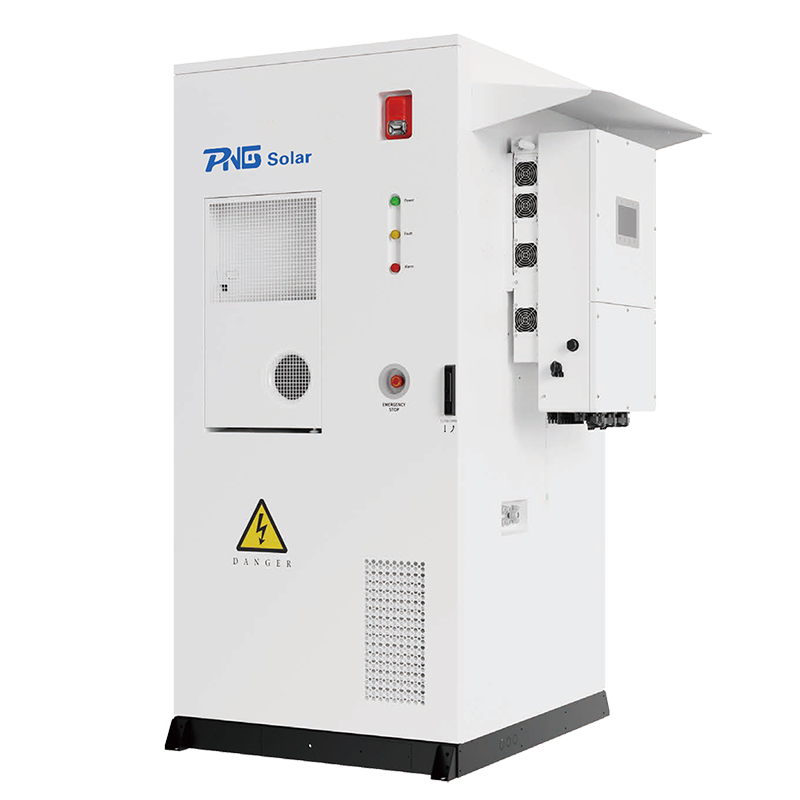
PNG Solar provides energy storage options for commercial and industrial projects. For example, its 50kW commercial energy storage system is listed with 100.3kWh and 114.6kWh storage configurations. These capacities can serve as reference points when discussing a project, but the final configuration should be selected according to the actual load profile and backup requirements.
Commercial and industrial battery energy storage system from PNG Solar.
Choosing Solar Panels and Inverters for Kenyan Conditions
Solar panels and inverters are central components of a commercial PV system. Their specifications should match the site conditions, electrical design and expected operating life of the project.
Solar panels: Compare module efficiency, rated power, temperature characteristics, mechanical load ratings, product warranty and performance warranty. N-type TOPCon modules are one option for commercial projects where high-power modules and efficient use of installation space are important. Panel selection should also consider roof structure, wind exposure, shading and maintenance access.
PNG Solar offers PV modules and complete solar system products, including N-type solar panels for commercial applications. The appropriate module model should be confirmed against the project's required capacity and electrical design.
Solar inverters: The inverter converts DC electricity from the PV array or battery into usable AC electricity. Commercial projects should check rated output power, phase configuration, input voltage range, MPPT design, overload capability, protection functions and monitoring options. Three-phase equipment is commonly relevant for larger commercial facilities, but the correct configuration depends on the site's electrical supply and connected loads.
Businesses can compare available solar inverter options and confirm whether the selected inverter supports the intended battery chemistry, grid connection and backup operating mode.
Kenyan installation sites can vary significantly in temperature, dust exposure, humidity and distance from technical support. Equipment should be selected with the actual installation environment in mind. Appropriate enclosures, ventilation, cable protection, grounding and surge protection are important parts of the complete system design.
Commercial Solar and Energy Storage for Larger Facilities
Large factories, agricultural processors, commercial buildings and industrial sites may require more than a small rooftop solar installation. Their projects can involve high-power inverters, substantial battery capacity, multiple PV strings and an energy management system that coordinates solar generation, grid power, battery charging and facility loads.
For these applications, an integrated commercial and industrial energy storage system can help manage peak demand, provide backup to selected loads and make better use of on-site solar generation. Whether these functions are financially beneficial depends on the local electricity tariff, demand-charge structure, operating schedule and system control strategy.
PNG Solar lists larger energy storage configurations, including a 100kW inverter with 215kWh LiFePO4 battery cabinet. Its product information describes an integrated battery energy storage solution with a battery management system and liquid cooling. Such equipment may be considered for suitable commercial and industrial projects after checking the required output power, usable energy, site conditions and grid requirements.
Solar energy storage equipment for projects requiring battery-backed power.
For larger installations, businesses should also request the system single-line diagram, protection design, equipment datasheets, communication protocol information and commissioning plan. These documents help the project engineer verify whether all components can work together safely and as intended.
How to Choose a Reliable Commercial Solar Supplier in Kenya
Choosing a solar supplier is not only about comparing the price per watt. A commercial solar project includes equipment selection, electrical integration, installation, commissioning, monitoring and long-term maintenance. A low initial quotation may not represent the best overall value if important components or services are excluded.
Before selecting a supplier or manufacturer, businesses should ask for clear answers to the following questions:
Can the supplier support the required project scale? Check whether its product range covers the required PV capacity, inverter power and battery storage.
Are technical specifications available? Request datasheets, system diagrams, protection details and warranty documents.
Can the system be customized? Commercial facilities often need configurations based on their actual load profile and operating conditions.
Is component compatibility documented? Confirm that panels, inverters, batteries and monitoring equipment are designed to work together.
What after-sales support is available? Clarify commissioning support, troubleshooting procedures, spare parts and warranty claim processes.
Who will handle local installation and maintenance? Confirm the responsibilities of the equipment supplier, local EPC contractor and site operator.
Businesses should also confirm that the proposed installation and equipment meet applicable Kenyan electrical, building and regulatory requirements. The project team should verify the latest requirements with the relevant local authorities and qualified professionals rather than relying on a generic equipment quotation.
PNG Solar, also known as Hefei Pinergy Solar Technology Co., Ltd, supplies PV modules, inverters, batteries and solar system solutions. Its product range includes on-grid, off-grid and hybrid configurations, as well as commercial and industrial energy storage products. Businesses can review the PNG Solar product range when preparing specifications for a commercial project.
What Should a Commercial Solar Quotation Include?
A useful quotation should make it possible to compare suppliers on a like-for-like basis. Instead of accepting a single system price, ask for a detailed breakdown of the equipment and services included.
PV module brand, model, quantity and total installed capacity.
Inverter brand, model, rated output and phase configuration.
Battery chemistry, nominal capacity, usable capacity and power rating.
Mounting structures, cables, combiner boxes and electrical protection devices.
Monitoring equipment and energy management functions.
Installation, transport, commissioning and testing responsibilities.
Product warranties, performance warranties and battery warranty conditions.
Expected maintenance requirements and after-sales support arrangements.
System assumptions, exclusions and any site preparation work required.
For projects in remote parts of Kenya, logistics and maintenance planning deserve particular attention. Businesses should understand how replacement components will be supplied, who can respond to faults and whether the system can be monitored remotely.
Is Commercial Solar Power Worth the Investment in Kenya?
Commercial solar can be a worthwhile investment when the system is matched to the business's electricity consumption and operating schedule. However, the payback period is not the same for every project. It depends on the installed cost, the amount of solar electricity used on site, electricity tariffs, battery replacement assumptions, maintenance expenses and financing costs.
For a grid-connected business that uses most of its electricity during the day, an on-grid system may offer a more straightforward starting point. A business that experiences costly power interruptions may find additional value in battery storage. A remote facility without a reliable grid connection may need an off-grid system even if its upfront investment is higher.
A practical financial assessment should compare at least two or three system configurations. It should estimate annual solar generation, self-consumption, grid electricity offset, battery losses, operating costs and the value of avoided downtime where this can be reasonably measured.
Rather than relying on a generic promise of a fixed payback period, businesses should request a project-specific financial model based on actual electricity bills and load data.
Why Consider PNG Solar for Commercial Solar Projects?
Commercial solar projects require coordinated equipment selection. Buying panels, inverters and batteries separately without checking compatibility can create integration challenges during installation and operation.
PNG Solar provides a range of solar products and system solutions, including N-type PV modules, solar inverters, lithium battery storage, on-grid systems, off-grid systems and hybrid solar systems. Its catalog also includes larger commercial and industrial energy storage configurations, giving project developers several equipment options to evaluate.
For businesses, distributors and project developers in Kenya, PNG Solar can be considered as an equipment and system solution supplier during the project planning process. The next step is to share the site's electricity consumption, required system capacity, grid conditions and backup expectations so that the proposed configuration can be reviewed against the actual application.
To explore available configurations, visit PNG Solar's solar system solutions or contact the company through its website to discuss commercial and industrial solar requirements.
Frequently Asked Questions About Commercial Solar in Kenya
What is the best solar power system for a business in Kenya?
The best system depends on grid access, electricity consumption and backup requirements. On-grid solar is suitable for many businesses with reliable grid access and daytime loads. Hybrid systems add battery backup, while off-grid systems are designed for facilities without dependable grid electricity.
How much solar capacity does a commercial building need?
There is no single capacity that fits every commercial building. The system should be sized using electricity bills, load profiles, equipment ratings, operating hours, available installation space and the required backup duration. A professional energy assessment is recommended before selecting the PV and inverter capacity.
Can commercial solar systems operate during a power outage?
Yes, if the system is designed with an appropriate backup function. A standard grid-tied inverter may shut down during a grid outage for safety reasons. A hybrid system with compatible battery storage and backup output can continue supplying designated loads when configured correctly.
Are LiFePO4 batteries suitable for commercial solar storage?
LiFePO4 batteries are widely used in stationary energy storage because of their cycle-life and thermal characteristics. Buyers should still compare usable capacity, power rating, battery management functions, operating temperature range, warranty conditions and system compatibility.
Can solar power run factory equipment and heavy machinery?
It can support many factory loads when the system is correctly engineered. The design must account for continuous power demand, motor starting current, surge loads, three-phase requirements and the power rating of the inverter. Some facilities may need a hybrid system or a combination of solar, grid and generator power.
Is battery storage necessary for a commercial solar system?
No. A business with reliable grid access and high daytime electricity consumption may benefit from an on-grid system without batteries. Battery storage becomes more relevant when the business needs backup power, uses electricity after sunset or operates in an area with unreliable grid supply.
What should businesses check before buying a commercial solar system?
Businesses should review equipment datasheets, system design, component compatibility, warranty terms, installation scope, monitoring functions, local compliance and after-sales support. A detailed quotation should clearly identify all included and excluded items.
Does PNG Solar offer commercial and industrial energy storage systems?
Yes. PNG Solar lists commercial and industrial energy storage products, including a 50kW system with 100.3kWh and 114.6kWh storage configurations and a 100kW system with a 215kWh LiFePO4 battery cabinet. The suitable model depends on the project's power and energy requirements.
{
"@context": "https://schema.org",
"@type": "FAQPage",
"mainEntity": [
{
"@type": "Question",
"name": "What is the best solar power system for a business in Kenya?",
"acceptedAnswer": {
"@type": "Answer",
"text": "The best system depends on grid access, electricity consumption and backup requirements. On-grid solar is suitable for many businesses with reliable grid access and daytime loads. Hybrid systems add battery backup, while off-grid systems are designed for facilities without dependable grid electricity."
}
},
{
"@type": "Question",
"name": "How much solar capacity does a commercial building need?",
"acceptedAnswer": {
"@type": "Answer",
"text": "There is no single capacity that fits every commercial building. The system should be sized using electricity bills, load profiles, equipment ratings, operating hours, available installation space and the required backup duration. A professional energy assessment is recommended before selecting the PV and inverter capacity."
}
},
{
"@type": "Question",
"name": "Can commercial solar systems operate during a power outage?",
"acceptedAnswer": {
"@type": "Answer",
"text": "Yes, if the system is designed with an appropriate backup function. A standard grid-tied inverter may shut down during a grid outage for safety reasons. A hybrid system with compatible battery storage and backup output can continue supplying designated loads when configured correctly."
}
},
{
"@type": "Question",
"name": "Are LiFePO4 batteries suitable for commercial solar storage?",
"acceptedAnswer": {
"@type": "Answer",
"text": "LiFePO4 batteries are widely used in stationary energy storage because of their cycle-life and thermal characteristics. Buyers should still compare usable capacity, power rating, battery management functions, operating temperature range, warranty conditions and system compatibility."
}
},
{
"@type": "Question",
"name": "Can solar power run factory equipment and heavy machinery?",
"acceptedAnswer": {
"@type": "Answer",
"text": "It can support many factory loads when the system is correctly engineered. The design must account for continuous power demand, motor starting current, surge loads, three-phase requirements and the power rating of the inverter. Some facilities may need a hybrid system or a combination of solar, grid and generator power."
}
},
{
"@type": "Question",
"name": "Is battery storage necessary for a commercial solar system?",
"acceptedAnswer": {
"@type": "Answer",
"text": "No. A business with reliable grid access and high daytime electricity consumption may benefit from an on-grid system without batteries. Battery storage becomes more relevant when the business needs backup power, uses electricity after sunset or operates in an area with unreliable grid supply."
}
},
{
"@type": "Question",
"name": "What should businesses check before buying a commercial solar system?",
"acceptedAnswer": {
"@type": "Answer",
"text": "Businesses should review equipment datasheets, system design, component compatibility, warranty terms, installation scope, monitoring functions, local compliance and after-sales support. A detailed quotation should clearly identify all included and excluded items."
}
},
{
"@type": "Question",
"name": "Does PNG Solar offer commercial and industrial energy storage systems?",
"acceptedAnswer": {
"@type": "Answer",
"text": "Yes. PNG Solar lists commercial and industrial energy storage products, including a 50kW system with 100.3kWh and 114.6kWh storage configurations and a 100kW system with a 215kWh LiFePO4 battery cabinet. The suitable model depends on the project's power and energy requirements."
}
}
]
}




 Email Us
 Call Us
 Address
 network supported


