What Are You Looking For?
Solar panels installed in the United Arab Emirates must operate under conditions that are very different from those in many temperate regions. High ambient temperatures, intense solar radiation, airborne sand and dust, and long periods of direct sunlight can all affect system performance. For developers, EPC contractors and solar distributors, choosing the right module is therefore about more than selecting the highest wattage on a product datasheet.
The most important factors include the panel's power temperature coefficient, cell technology, module construction, resistance to environmental stress and suitability for the installation site. This guide explains how to choose solar panels for the UAE desert climate and how to evaluate high-temperature performance using actual technical specifications. It also introduces relevant N-type TOPCon and bifacial solar modules from PNG Solar.
The UAE receives abundant sunlight, which creates strong potential for solar electricity generation. However, high solar irradiance does not automatically mean that a solar panel will operate at its rated power throughout the day. Module temperature rises when sunlight heats the panel, and this temperature increase reduces the electrical output of conventional crystalline silicon modules.
Several environmental factors should be considered when selecting modules for desert projects:
These factors do not mean that solar panels are unsuitable for desert environments. They mean that module selection, system design, installation and maintenance must be considered together.
The power temperature coefficient indicates how much a solar module's maximum power changes as its cell temperature moves above or below the standard reference temperature of 25°C. For high-temperature locations such as the UAE, a lower absolute temperature coefficient is generally preferable because the module loses less power for each degree of temperature increase.
For example, consider a solar panel with a power temperature coefficient of -0.36%/°C. If its cell temperature rises from the 25°C reference point to 65°C, the estimated power reduction caused by temperature alone is approximately:
40°C × 0.36% = 14.4%
This is a simplified calculation based on the stated coefficient. It does not represent the complete real-world energy loss of a solar installation. Actual output also depends on irradiance, wind, mounting conditions, electrical characteristics, inverter behavior, shading and soiling.
When comparing solar panels for UAE projects, do not look only at the rated wattage. Check the temperature coefficient of Pmax in the technical datasheet and compare models under the same testing and measurement conditions.
There is no single temperature coefficient that guarantees suitability for every desert installation. However, when two modules have similar power ratings and other comparable specifications, the module with the lower absolute Pmax temperature coefficient generally has an advantage under high cell temperatures.
For reference, PNG Solar lists the following temperature characteristics for selected N-type TOPCon modules:
The figures above are model-specific. Buyers should confirm the latest datasheet and exact module model before making a technical or commercial decision. A lower temperature coefficient is useful, but it should not replace checks on efficiency, mechanical construction, warranty, degradation, certifications and project compatibility.
For project teams comparing module specifications, PNG Solar's 470W–500W N-type Mono TOPCon solar module provides a useful example of the technical information that should be reviewed, including temperature characteristics, operating temperature range and mechanical specifications.
N-type TOPCon is a widely used high-efficiency crystalline silicon cell technology. It can be a suitable option for utility-scale, commercial and industrial solar projects where developers need efficient use of installation space and competitive module output.
When evaluating N-type TOPCon modules for desert applications, pay attention to the following characteristics:
PNG Solar offers N-type Mono TOPCon modules in different power ranges. Its 610W–635W N-type double-glass bifacial solar panel is one option for larger projects that require high-power modules. The product page lists a 1500V DC maximum system voltage, IP68 junction box and a Pmax temperature coefficient of -0.36%/°C.
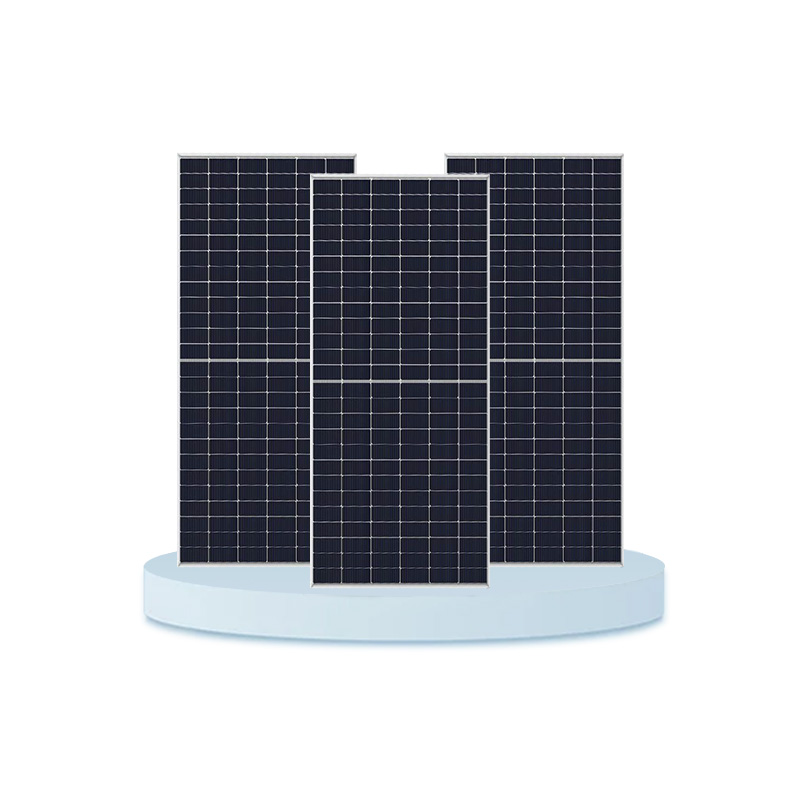
PNG Solar N-type TOPCon solar modules for commercial and utility-scale applications.
Double-glass and bifacial modules are worth considering for many large solar projects in the UAE, but they serve different purposes and should not be treated as interchangeable terms.
Double-glass construction uses glass on both the front and rear sides of the module. Depending on the product design and materials, this construction can provide additional protection for the encapsulated cells and may be suitable for projects where long-term environmental durability is a priority. Buyers should still check the module's certified test results and warranty conditions.
Bifacial technology allows a module to generate electricity from both its front and rear surfaces. The additional rear-side energy depends on reflected light from the ground and surrounding surfaces, module height, row spacing, mounting structure and ground albedo.
In desert projects, sand color and ground conditions can influence reflected irradiance, but the actual bifacial gain should not be assumed from the module type alone. A project-specific energy simulation is more reliable than using a generic bifacial gain percentage.
PNG Solar's 600W–625W double-glass bifacial TOPCon module is another product option for developers comparing high-power module formats. Its product specifications list N-type cells, double-glass construction, an IP68 junction box and a 1500V DC maximum system voltage.
Dust and sand accumulation can reduce solar panel output by blocking sunlight from reaching the photovoltaic cells. In desert and semi-arid locations, soiling can become a significant factor in annual energy yield, particularly when rainfall is limited and cleaning intervals are too long.
Dust performance is not determined by the panel's cell technology alone. It is influenced by site conditions and the design of the complete installation. Factors include:
For a UAE solar project, developers should prepare a practical cleaning and inspection plan before commissioning. Cleaning frequency should be based on measured soiling losses, site conditions and the cost-benefit of maintenance rather than a fixed schedule applied to every location.
Dry brushing or unsuitable cleaning tools can scratch module glass. High-mineral-content water may also leave deposits. Follow the module manufacturer's cleaning instructions and use suitable methods, especially for large commercial and utility-scale installations.
Temperature coefficient is important, but it is only one part of the module selection process. A panel installed in the UAE should also be evaluated for mechanical strength, electrical safety and environmental durability.
Operating temperature range: Check the manufacturer's specified operating temperature range. This indicates the conditions under which the module is designed to operate, but it does not mean that power output remains unchanged across that range.
Junction box protection: An IP-rated junction box helps protect electrical connections against dust and water ingress under the defined test conditions. Confirm the rating and installation requirements in the product datasheet.
Glass and frame construction: Review glass thickness, frame material, corrosion resistance and mechanical load ratings. These details matter for long-term installation stability.
Wind load and mounting design: Desert sites can experience strong winds and blowing sand. Module mechanical ratings must be considered together with the mounting structure, foundation design, roof condition and local engineering requirements.
Certifications and warranty: Ask for applicable IEC test certificates, product warranty documents and linear power warranty terms. Confirm that the documents apply to the exact model being supplied.
For example, PNG Solar's 610W–635W bifacial module page lists an operating temperature range of -40°C to +85°C, an IP68 junction box and mechanical load ratings. These specifications should be reviewed alongside the project's site-specific engineering requirements, rather than interpreted as a blanket guarantee of performance under every desert condition.
Even a well-selected solar module can underperform if the installation does not allow appropriate airflow, drainage and maintenance access. In hot climates, system design should address heat management from the beginning.
For complete installations, module selection must also be coordinated with inverter specifications. Review the available PNG Solar inverter range and confirm the DC input voltage, current limits, MPPT range, string configuration and temperature-related voltage variations before finalizing the design.
Large solar projects in the UAE often use high-power modules to improve installation efficiency and reduce the number of modules and connections required for a given DC capacity. However, the highest-wattage panel is not automatically the best choice. Module dimensions, weight, current, voltage and mounting compatibility all affect project economics and design.
For commercial rooftops, the available roof area, structural loading and electrical layout may determine the most suitable module size. For ground-mounted projects, developers may have more flexibility to use larger modules, but transport, handling, mounting and row spacing still need to be considered.
PNG Solar supplies different module power ranges, including its 460W–485W N-type TOPCon module. The listed product specification includes a Pmax temperature coefficient of -0.26%/°C. This makes it a useful model to compare when temperature-related power loss is an important selection factor. The final decision should still consider the full datasheet and project design.
For projects that combine PV generation with energy storage, developers can also review PNG Solar's hybrid solar system solutions. The choice between grid-connected, hybrid and other system configurations depends on the project's energy profile, grid requirements and backup objectives.
Choosing a solar panel supplier involves more than comparing the price per watt. For projects in hot and dusty environments, buyers should verify that the supplier can provide consistent product documentation and technical support throughout the procurement process.
Before placing an order, request and review the following information:
It is also useful to compare the supplier's proposed module against the project's technical specification. If the quotation lists only wattage and price, ask for the missing electrical, mechanical and warranty details before making a decision.
PNG Solar, also known as Hefei Pinergy Solar Technology Co., Ltd., offers N-type TOPCon modules in several power ranges, including monofacial and bifacial options. Its product portfolio also covers inverters, batteries and solar system solutions. Buyers can review the PNG Solar product catalog to compare available product categories and module configurations.
Solar projects in the UAE require modules that are selected according to measurable performance characteristics and verified product specifications. PNG Solar provides N-type TOPCon solar modules in different power ranges, with product options that include bifacial and double-glass designs.
For buyers evaluating desert solar applications, PNG Solar's product range provides several specifications to compare, including module power, efficiency, Pmax temperature coefficient, operating temperature range, junction box protection and mechanical construction. The 460W–485W full-black module, for example, lists a Pmax temperature coefficient of -0.26%/°C, while selected 470W–500W and 610W–635W models list -0.36%/°C.
These differences show why it is important to compare exact module models rather than making assumptions based on technology names alone. Project developers, EPC contractors and distributors can share their target capacity, installation type and site conditions with PNG Solar to identify suitable module options and obtain the corresponding technical documentation.
For more information about solar modules and system products, visit PNG Solar and review the available product specifications before preparing your project design.
Which solar panels are best for the UAE desert climate?
Solar panels for the UAE should have a low absolute Pmax temperature coefficient, suitable mechanical construction, reliable electrical protection and verified environmental test documentation. N-type TOPCon modules are one option, but the exact datasheet values and project conditions should guide the final selection.
What is a good temperature coefficient for solar panels in hot climates?
A lower absolute Pmax temperature coefficient is generally preferable because it indicates a smaller power reduction for each degree Celsius increase in cell temperature above the reference point. Compare the actual coefficient of each module rather than relying on broad technology claims.
How much power do solar panels lose in high temperatures?
Power loss depends on the module's Pmax temperature coefficient and actual cell temperature. For example, a module with a -0.36%/°C coefficient would have an estimated temperature-related power reduction of about 14.4% when cell temperature reaches 65°C, compared with the 25°C reference temperature. This is a simplified estimate, not a full system energy-yield calculation.
Are N-type TOPCon solar panels suitable for desert projects?
N-type TOPCon modules can be suitable for desert projects when their temperature coefficient, efficiency, reliability tests, mechanical specifications and warranties meet project requirements. Not all TOPCon modules have identical temperature performance, so buyers should compare exact product datasheets.
Are bifacial solar panels worth using in the UAE?
Bifacial modules can generate additional electricity from reflected light reaching the rear surface. The actual energy gain depends on ground reflectivity, mounting height, row spacing, shading and site layout. A project-specific simulation should be used to estimate the benefit.
Does desert dust damage solar panels?
Dust accumulation mainly reduces energy production by blocking sunlight. Blowing sand may also create surface abrasion over time, depending on exposure and module construction. Regular inspection, suitable cleaning methods and a site-specific maintenance plan help manage these risks.
Why is rear ventilation important for solar panels in hot climates?
Airflow behind a solar module helps remove heat and can reduce operating temperature. Mounting design should provide suitable ventilation while meeting structural, wind-load and installation requirements.
Which PNG Solar modules can buyers compare for high-temperature applications?
PNG Solar lists several N-type TOPCon options, including 470W–500W Mono TOPCon modules, 610W–635W double-glass bifacial modules and 460W–485W full-black modules. Their listed Pmax temperature coefficients differ, so buyers should review the exact model datasheet before selecting a module.



Signup our newsletter to get update information, promotion and insight.

 Email Us
Email : [email protected]
 Call Us
Tel : +8615606821994
Whatsapp : +8615606821994
 Address
No.6, Linquan East Road,Feidong New City Economic Development Zone, 231600 Hefei ,Anhui Province PRC.
© Hefei Pinergy Solar Technology Co., Ltd .All Rights Reserved. Sitemap | Blog | XML | Privacy Policy
 network supported


